
Which TV services are available to you depends mostly on your address: cable and satellite providers build out infrastructure region by region, so coverage genuinely varies from one street to the next. Here's how to actually check what's available where you live, plus a category of service that sidesteps the location question entirely.
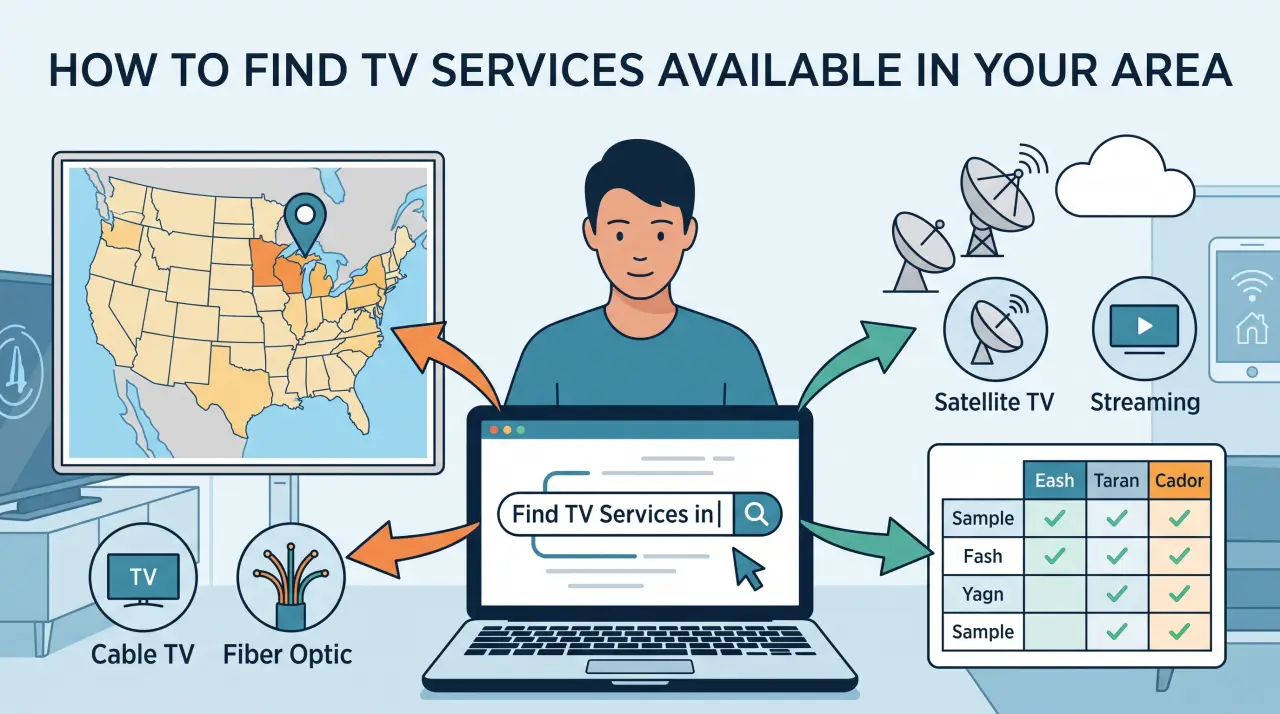
Why TV Availability Varies by Address
Cable providers deliver service over physical coaxial lines built out neighborhood by neighborhood, so a provider serving one side of town may not reach the other. Satellite providers cover much broader areas since they beam from orbit rather than a buried cable, but they still depend on a clear, unobstructed view of the sky from your specific property — trees, tall buildings, or a bad-facing roofline can rule it out even within a technically "covered" region.
This is the actual reason "TV services in my area" doesn't have one universal answer: it's genuinely address-specific, not just a marketing quirk.
How to Check What's Actually Available
- Provider websites directly: Most cable and satellite providers let you enter your address or ZIP code to see confirmed availability and current packages for that specific location.
- Call or chat with providers: For edge cases — new construction, rural addresses, or buildings with unusual wiring — a direct call often gets a faster, more accurate answer than an automated address checker.
- Ask neighbors or property management: In apartments or HOAs, there's sometimes an existing wiring agreement with a specific provider, which can make one option easier to set up than others.
The Service Types You'll Typically Find
Depending on your address, the options that come up usually fall into a few categories: a local cable provider, one or more satellite providers, a phone company's fiber or DSL-based TV service where available, and, increasingly, a streaming alternative that isn't tied to infrastructure at all. Our guide to choosing a cable provider and satellite TV provider guide cover what to evaluate within those first two categories specifically.
The Option That Isn't Tied to Your Address
IPTV services work differently from cable or satellite in one important way: since they're delivered over your existing internet connection rather than dedicated TV infrastructure, there's no regional buildout or line-of-sight requirement to worry about. If your address has a stable internet connection, an IPTV subscription works the same way it would anywhere else.
GetTV.online is one example — it delivers 40,000+ live channels and 150,000+ movies and series without depending on which cable company happens to serve your street. For anyone who's checked local availability and come up short, or just wants to skip the address-lookup step entirely, that's the practical alternative. Our guide to setting up IPTV on any device covers how the setup actually works.
FAQ
Why isn't the same TV provider available everywhere?
Cable providers build physical infrastructure region by region, so coverage is genuinely address-specific rather than a marketing distinction. Satellite covers a broader footprint but still depends on a clear view of the sky at your property.
How do I find out what's available at my address?
Most providers offer an address or ZIP code lookup on their website. For unusual cases like new construction or rural addresses, calling the provider directly often gets a faster answer.
Is there a TV service that works no matter where I live?
IPTV services, which run over your internet connection instead of dedicated cable or satellite infrastructure, aren't restricted by regional coverage the same way. As long as you have a stable internet connection, the service works the same regardless of address.
Can I try an IPTV service before switching?
GetTV.online's free trial is one way to confirm it works well on your own connection and devices before committing.