
The core difference between traditional TV and streaming services comes down to delivery and commitment: traditional cable or satellite TV runs over dedicated provider infrastructure with a fixed channel lineup and, typically, a contract, while streaming services deliver content over your existing internet connection with far more flexibility to start, stop, or switch month to month.
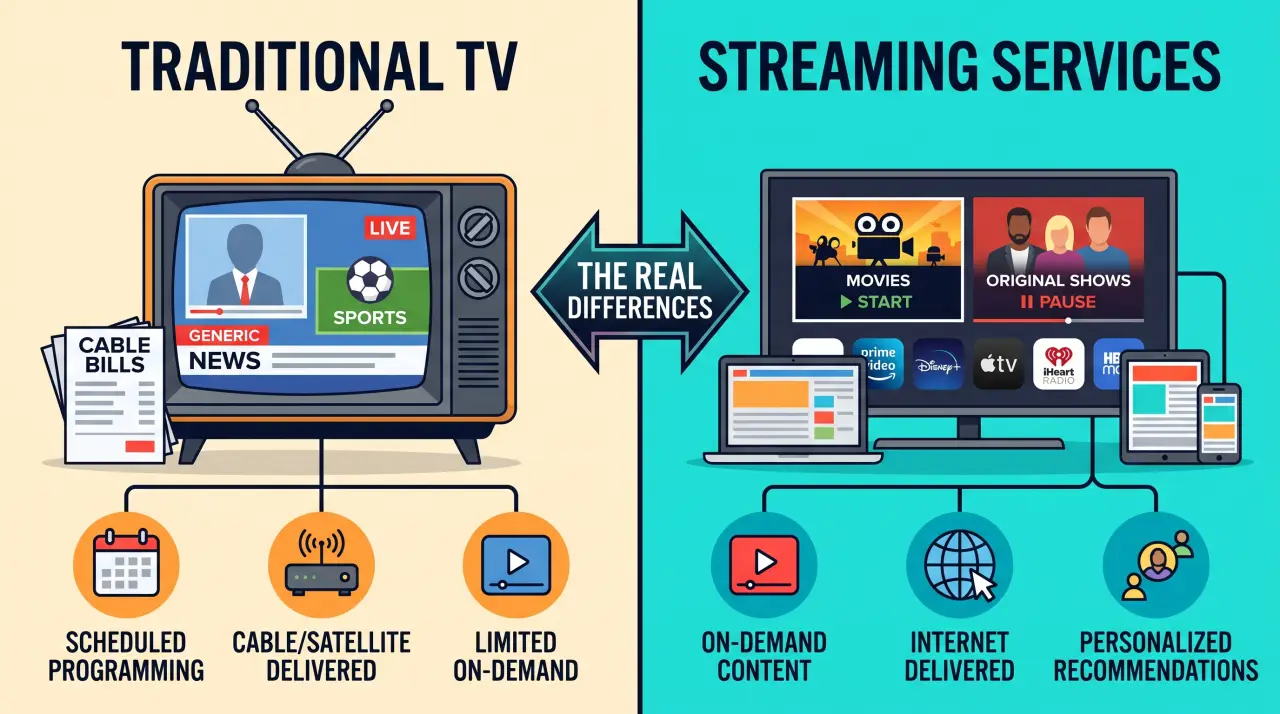
Traditional TV vs. Streaming at a Glance
| Factor | Traditional TV (cable/satellite) | Streaming services |
|---|---|---|
| Delivery method | Dedicated coaxial line or satellite dish | Your existing internet connection |
| Contract | Often requires a fixed-term contract | Typically month-to-month, cancel anytime |
| Equipment | Set-top box or satellite receiver, usually rented | Smart TV, streaming device, phone, or computer you likely already own |
| Channel access | Fixed lineup set by the provider's package tier | Varies by service — from on-demand libraries to live-channel bundles like GetTV.online |
| Installation | Often requires a technician visit | Self-setup, typically an app download and login |
How Traditional Cable and Satellite TV Works
Traditional TV depends on infrastructure built specifically to deliver television: a coaxial cable run to your home, or a satellite dish with a clear line of sight to the sky. The provider controls that physical delivery path end to end, which is part of why installation often involves scheduling a technician and why the channel lineup is locked to whatever package tier you're paying for.
This model has been the default for television for decades, and it still offers some things streaming doesn't automatically replicate — most notably, a single, unified program guide covering every channel in the package, and reception that doesn't depend on your home internet connection's speed or stability.
How Streaming Services Work
Streaming services skip dedicated TV infrastructure entirely and use the same general-purpose internet connection you already have for everything else. Content — whether an on-demand library or a live-channel feed — is delivered as internet data to whatever device you're watching on: a smart TV, a streaming stick, a phone, or a browser.
Because there's no dedicated line to install, setup is usually just downloading an app and logging in. That's also what makes switching services, adding one, or cancelling another so much faster than it typically is with a cable contract — there's no technician visit required in either direction.
The Differences That Actually Matter
- Commitment: Cable and satellite often lock you into a contract with early-termination fees; most streaming services bill month to month with no penalty for leaving.
- Equipment ownership: Traditional TV frequently involves a rented set-top box with its own monthly fee; streaming typically runs on hardware you already own.
- Content model: Traditional TV is built around a single fixed channel lineup. Streaming ranges from pure on-demand libraries to live-channel IPTV bundles, so the actual content model depends entirely on which streaming service you choose.
- Dependency: Traditional TV reception isn't affected by your internet connection; streaming quality is directly tied to your internet speed and stability.
- Bundling flexibility: It's common to run more than one streaming service at once — a live-channel IPTV subscription alongside an on-demand library, for instance — in a way that doesn't really have a cable equivalent.
Who Should Pick Which
If a stable connection isn't guaranteed where you live, or you want one unified guide across every channel without depending on internet quality, traditional cable or satellite still has a real advantage. If flexibility matters more — the ability to change your lineup, avoid a contract, and skip a technician visit — streaming is the better fit for most households today.
For anyone who specifically wants the live-channel experience of cable without the contract or rented equipment, an IPTV subscription is the closest match: GetTV.online delivers 40,000+ live channels and 150,000+ movies and series over the internet, with no long-term contract. Our guide to setting up IPTV on any device covers what that setup actually looks like.
FAQ
Is streaming cheaper than cable?
It depends on how many services you subscribe to and what channels you need. A single streaming service is often cheaper than a full cable package, but stacking several services to match cable's channel breadth can close that gap. Comparing your actual channel needs against a specific plan is the only reliable way to know.
Do I need cable to get live TV channels?
No. Live-channel streaming, including IPTV services, delivers many of the same channels over the internet instead of a cable line. Our breakdown of live TV app types covers the different ways this works.
Does streaming require a contract like cable does?
Most streaming services are month-to-month with no long-term commitment, which is one of the biggest practical differences from a typical cable contract.
Can bad internet affect streaming quality?
Yes. Unlike traditional cable or satellite reception, streaming quality depends directly on your internet connection's speed and stability. A slow or unstable connection can cause buffering or lower resolution.
Can I try streaming before fully switching from cable?
GetTV.online's free trial is one way to test a live-channel streaming setup on your own equipment before deciding to switch entirely.